What Are AI Agents and Which One Should You Choose in 2026: OpenClaw, Hermes, Cowork, and More
AI agents no longer just respond — they act. We explain the difference from chatbots and compare the top agents of 2026 so you can choose the right one.
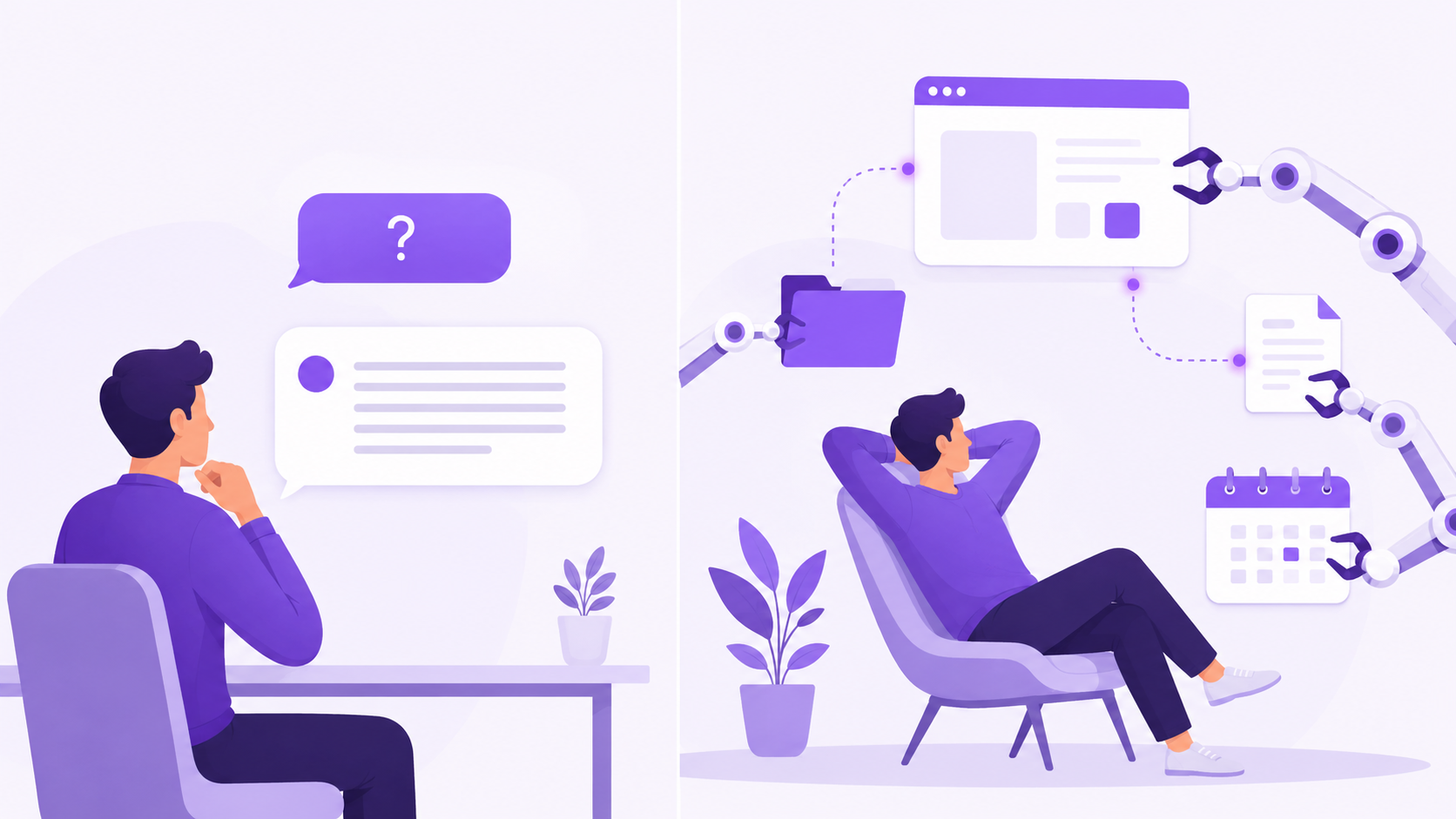
For years, the promise of artificial intelligence was the same: a chat box where you type a question and get an answer. Useful, yes. But you still had to do the work.
In 2026, that changed. AI agents don’t just respond — they act. They schedule meetings, manage files, write and send emails, browse the web, and execute complete workflows while you do something else. The difference isn’t one of degree: it’s one of kind.
This guide explains exactly what agents are, how they differ from AI chat, and compares the four most relevant ones right now: OpenClaw, Hermes Agent, Claude Cowork, and ChatGPT Agent.
Chatbot vs agent: what’s the real difference
A chatbot or conversational AI assistant (ChatGPT, Claude, Gemini in chat mode) works like this:
- You type a question or instruction
- The model generates a text response
- You read the response and decide what to do with it
- You execute the action
The model talks. You do the work.
An AI agent works differently:
- You describe a goal
- The agent plans the necessary steps
- The agent executes those steps using real tools (browser, file system, APIs, apps)
- The agent delivers the finished result
The model acts. It does the work.
A concrete example: you tell Claude in chat mode “find me flights to Madrid on June 15th.” Claude will explain how to search for flights. You tell the same thing to a well-configured agent: the agent opens the browser, compares prices across multiple sites, filters by your saved preferences, and presents you the three best options ready to book.
This practical difference is what’s generating so much interest in 2026. Agents aren’t an incremental improvement over chatbots — they’re a new category.
Why agents are exploding right now
Three technical factors converged in 2025–2026 to take agents from experiment to real tools:
Models improved at long-range reasoning. An agent needs to plan a sequence of steps, adapt when something fails, and keep the goal in mind for several minutes or more. Earlier models got lost. Current ones handle it well.
The MCP (Model Context Protocol) standard was widely adopted. Developed by Anthropic and adopted by OpenAI, Google, and most open source frameworks, MCP allows any agent to connect to external tools (Gmail, Slack, GitHub, databases) in a standardized way — no custom code per integration.
Local hardware improved. Some agents run directly on your computer. With today’s chips, running 7B–14B parameter models locally is viable for everyday use, enabling agents that work without uploading your data to any server.
The 4 main agents in 2026
OpenClaw — the open source agent that went viral
In January 2026, an Austrian engineer named Peter Steinberger launched an open source agent that could do something most assistants couldn’t: act on its own. Within 48 hours, the project surpassed 100,000 GitHub stars.
OpenClaw started as Clawdbot in November 2025, and the name change tells part of the story. It’s an autonomous, open source AI agent that runs on your local machine and connects language models directly to your operating system, files, messaging apps, and the web.
What it can do:
- Read and write files on your computer
- Browse the web and fill out forms
- Send emails and messages via WhatsApp, Telegram, Discord, or Slack
- Execute scripts and system commands
- Manage multi-step workflows in the background
With over 100 pre-configured AgentSkills, OpenClaw connects AI directly to your apps, browser, and system tools. The project is model-agnostic: you can use your own API key for cloud models or run local models on your own infrastructure.
What you should know before using it:
OpenClaw had a critical vulnerability (CVE-2026-25253) that exposed between 30,000 and 42,000 instances on the internet, 93% without authentication. Additionally, attackers introduced over 1,184 malicious skills into ClawHub, the official plugin marketplace. These issues have since been patched, but it’s a signal that using OpenClaw requires care with configuration.
The creator joined OpenAI in February 2026, and the project transitioned to a foundation backed by OpenAI, but remains open source under the MIT license.
Ideal profile: Technical users or those willing to learn, who want maximum control and privacy and don’t mind setting up the environment.
Cost: Free (open source). You pay for the API usage of whatever model you choose: between $5 and $20/month for moderate use.
Hermes Agent — the agent that learns as you use it
Hermes Agent is an autonomous open source AI agent built by Nous Research, launched in February 2026. It’s not a coding copilot tied to an IDE or a chatbot wrapper over an API. Hermes lives on your server, remembers what it learns, and becomes more capable the longer it runs.
What distinguishes Hermes from all other agents is its continuous learning loop. Every task it completes becomes experience the agent can reuse in the future. Over time, it creates its own automated skills based on patterns in your work.
What it can do:
- Everything OpenClaw does, but with persistent memory across sessions
- Create and reuse skills it learned from your usage
- Connect to Telegram, Discord, Slack, or WhatsApp as a control channel
- Integrate MCP to connect with external tools
- Generate training data and run RL experiments
Unlike single-run agents, Hermes Agent is the only open source agent with a real built-in learning loop. It doesn’t just complete tasks — it remembers, builds reusable skills, and gets smarter every time you use it.
Security advantage: Unlike OpenClaw, Hermes has had zero reported CVEs to date, making it a more solid choice for those handling sensitive information.
Ideal profile: Technical users who want an agent that improves over time and plan to use it continuously for months.
Cost: Free (open source, MIT license). You need your own server to run it (VPS from ~$5/month) plus the cost of the model API.
Claude Cowork — the agent for non-technical users
Announced in January 2026, Cowork is Anthropic’s research product that turns Claude into a digital coworker. You point it at a folder and describe what you need. Maybe that’s organizing a chaotic downloads folder, or extracting expense data from a bunch of receipt screenshots. Claude determines the steps and handles it.
Cowork’s proposition is different from OpenClaw and Hermes: you don’t need any technical knowledge to use it. It runs inside the Claude desktop app, with the same chat interface you already know, but with the ability to act on your files and applications.
What it can do:
- Analyze and reorganize files on your computer
- Read documents and generate summaries, reports, or updates
- Connect to Google Drive, Gmail, and DocuSign
- Complete multi-step workflows over documents
- Run specialized plugins (Cowork has plugins for finance, law, and more)
The agent can perform a series of operations such as analyzing a set of files, extracting relevant information from them, and then generating a summary or updating existing documents. Anthropic presents Cowork as a consumer version of Claude Code, its agent originally designed for developers.
Ideal profile: Knowledge workers (lawyers, consultants, analysts, managers) who want to delegate repetitive document tasks without touching anything technical.
Cost: Included in Claude Pro ($20/month). Enterprise access has separate pricing depending on the plan.
ChatGPT Agent — OpenAI’s agent integrated into ChatGPT
ChatGPT Agent represents the consolidation of OpenAI’s “Operator” project into a unified consumer-ready experience. The previous Operator tool has been discontinued, with all autonomous capabilities integrated directly into ChatGPT through the new Agent Mode.
ChatGPT Agent is the most accessible of all: if you already have a ChatGPT Pro or Team account, you simply activate agent mode in a conversation and can ask it to act, not just respond.
What it can do:
- Browse the web autonomously and complete forms
- Research and compile extensive reports (Deep Research)
- Interact with web interfaces for bookings, orders, or software management
- Connect with Google Drive and Microsoft 365
- Execute multi-step tasks without constant supervision
Main limitation: As an OpenAI cloud service, all information it processes passes through their servers. For users with confidential data, this is an important consideration.
Ideal profile: Users already paying for ChatGPT Pro who want to get started with agents without configuring anything. The lowest barrier to entry of the four.
Cost: Included in ChatGPT Pro ($20/month) and Team ($30/user/month).
Comparison: which agent is right for you?
| OpenClaw | Hermes Agent | Claude Cowork | ChatGPT Agent | |
|---|---|---|---|---|
| Technical or non-technical | Technical | Technical | Non-technical | Non-technical |
| Price | Free + API | Free + server | From $20/month | From $20/month |
| Local data | ✅ Yes | ✅ Yes | ⚠️ Partial | ❌ No |
| Learns with use | ❌ No | ✅ Yes | ❌ No | ❌ No |
| Messaging channels | WhatsApp/Telegram/Discord/Slack | Telegram/Discord/Slack/WhatsApp | ❌ No | ❌ No |
| No-code | ❌ No | ❌ No | ✅ Yes | ✅ Yes |
| Security | ⚠️ Past CVEs | ✅ No CVEs | ✅ High | ✅ High |
| Model-agnostic | ✅ Yes | ✅ Yes | ❌ Claude only | ❌ OpenAI only |
Where to start based on your profile
If you’re a non-technical user and want to start today: Claude Cowork or ChatGPT Agent. Both work within interfaces you already know, with no installation or configuration. Choose Cowork if you already use Claude; Agent if you already use ChatGPT Pro.
If you’re a developer or technical user and value privacy: OpenClaw for a mature skills ecosystem and large community. Hermes Agent if you plan to use it for months and want it to improve with your usage.
If you handle confidential information: Hermes Agent is the most solid option in terms of security among open source options, with zero reported CVEs and full control over where your data runs.
If you want the lowest startup cost: OpenClaw and Hermes Agent are free. You only pay for the AI model running underneath.
What this shift really means
The transition from chatbots to agents isn’t just technological — it’s a mindset shift. With a chatbot, the right question is “how do I do X?”. With an agent, the right question is “what result do I need and by when?”.
Professionals who master this difference, and who learn to describe goals in a way an agent can execute, will have a real advantage in the coming years. Not because agents are magic, but because most people are still watching from the outside.
Interested in automating your workflow with AI? Also read: How to Write AI Prompts That Actually Work and How to Summarize PDFs with AI for Free.